How to Pick Multiple Winners for Different Prizes
Plan a giveaway with several prizes: decide who can win what, set winners and backups per prize, choose the draw order and announce every result.
By the Winologic team · Updated: · How we write our guides
To pick multiple winners, list each prize with the number of winners it needs, decide whether one person may win more than once, set backup winners for every prize and draw from one fixed entry list without replacement. Announce all winners together with the prize each one won.
Map prizes to winners before you start
Begin with a simple table: each prize, the number of winners it has and the number of backups. A giveaway might have one bicycle, three shop vouchers and ten sticker packs, which is three prizes and fourteen winners in total. Writing this down first stops the draw from becoming improvised.
Several smaller prizes often make more people happy than one large one, but each prize still needs to be described clearly. Say what it is, who provides it and any conditions such as expiry dates or delivery areas.
Think about the total workload as well. Fourteen winners means fourteen messages, fourteen addresses and fourteen deliveries, so be realistic about how many prizes you can fulfil quickly. If the workload looks too heavy, reduce the number of prizes rather than delivering some of them late.
Decide whether one person can win twice
Most organisers allow one prize per person, because it spreads the rewards and feels fairer to everyone watching. If you want that rule, remove each winner from the pool the moment they are drawn so the same name cannot appear again.
State the rule in your giveaway terms. People are far more relaxed about results when they know in advance that nobody can take two prizes, and the rule also saves you from awkward decisions if a name comes up a second time. If you do allow multiple wins, say so openly, for example one grand prize per person plus any number of small ones.
Choose the draw order
You can draw the top prize first or finish with it. Starting with the big prize rewards the most attentive viewers, while saving it for last builds a climax on a stage or a live stream. Either order is fair as long as it is announced before the first draw.
Because winners leave the pool, the order does not change anyone's chance in a way that favours one person over another. Each draw is still a random pick from everyone who remains.
On a live stage the order is part of the show. Many presenters start with the smallest prizes to keep everyone hopeful and finish with the grand prize, while online giveaways often reveal the main prize first so nobody has to wait.
Give every prize its own backups
Backup winners should be drawn per prize and in order, so a prize that cannot be delivered passes to the next name on its own list. For example, one phone plus two backups, three vouchers plus two backups and ten stickers plus three backups.
Scale the backups to the effort of replacing a winner. A prize that must be posted to an unknown address deserves more backups than a voucher handed over in person at the event. Apply the same logic to every prize of the same type so nobody can argue that some winners were treated differently.
- High-value or shipped prizes: two or three backups.
- Prizes handed over in person: one backup is often enough.
- Announce backups in order and say how long each winner has to reply.
Running it in Winologic
Winologic lets you add several prizes to one giveaway, each with its own number of winners and backup winners. Drawn participants leave the pool automatically, duplicate entries are removed before the draw, and you can reveal each prize on any of the seven draw screens.
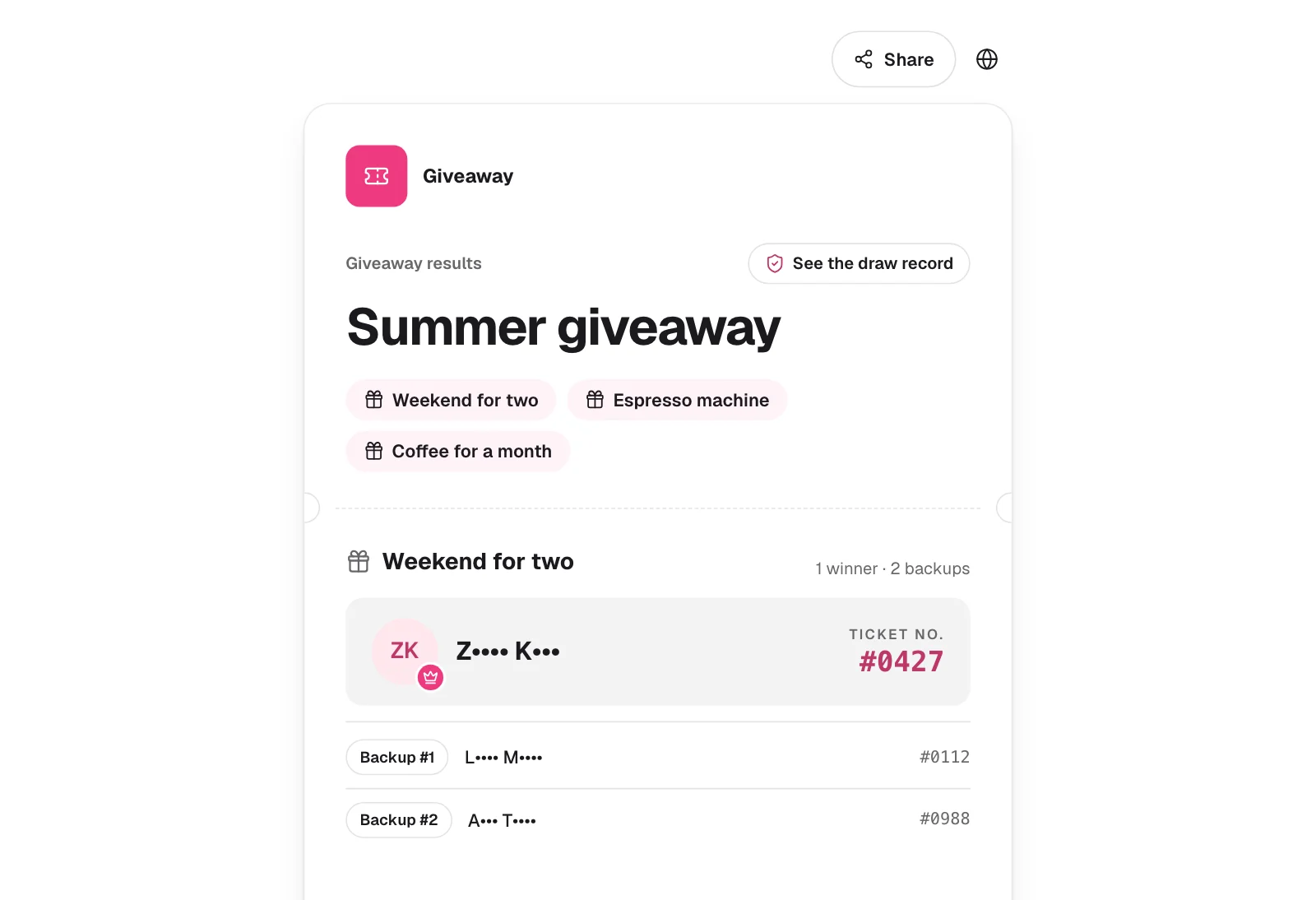
A public results page can list every prize with its winners and backups and their ticket numbers, with names masked if you prefer. Each draw is also saved with its random seed and a fingerprint of the entry list, kept in your dashboard.
Before you draw, check the prize list against your stock. The results page lists each prize with its winners and backups, which makes it easy to match the draw to the prizes you have physically prepared.
Step by step
- 01List the prizes
Write down each prize, the number of winners it needs and any conditions that apply.
- 02Set the one-prize rule
Decide whether a person can win more than once and put the decision in your rules.
- 03Add backups per prize
Choose how many backup winners each prize needs, based on its value and how it is delivered.
- 04Fix the entry list
Remove duplicates and ineligible entries, then lock the list before drawing.
- 05Draw prize by prize
Run each prize in the announced order, removing winners from the pool as they are drawn.
- 06Announce everything together
Publish all winners and backups with the prize each one won and the claim deadline.
Frequently asked questions
How many winners should a giveaway have?
+
It depends on your goal and budget. A single big prize creates excitement, while several smaller prizes spread goodwill to more people. Choose the number that your budget can honestly deliver.
Can one person win more than one prize?
+
Only if your rules allow it. Most organisers limit it to one prize per person and remove winners from the pool as they are drawn.
Should I draw all winners at once or one at a time?
+
Either works. Drawing prize by prize suits live events because each reveal gets its own moment, while a single combined draw is quicker for online announcements.
Do all prizes need backup winners?
+
Not necessarily, but any prize that needs a reply or a delivery address benefits from at least one backup. It keeps the giveaway moving if a winner never responds.
Related guides
All guidesBackup winners keep a giveaway moving when the first winner never replies. Learn how many to draw per prize, in what order and how to use them fairly.
Find giveaway prize ideas for every budget and audience, from low-cost digital perks to bigger bundles, plus checks to run before you promise a prize.
Announce giveaway winners in a way that builds trust: what to include, a public post and private message template, and how to share proof of the draw.