How to Prove a Giveaway Draw Was Fair
Learn the four ingredients of a provable giveaway draw: published rules, a fixed entry list, a random method and a saved record of the result.
By the Winologic team · Updated: · How we write our guides
You can prove a giveaway draw was fair by publishing the rules first, fixing and saving the entry list, using a random method you cannot steer, and keeping a record of the result. A good record saves the draw's random seed and a fingerprint of the entry list, so you can show later that nothing was changed.
Why saying trust me is not enough
Participants cannot see what happens behind a screen. When a winner is a relative, an employee or simply a name nobody knows, doubts appear, and a quiet comment in the replies can grow into a public accusation. The best defence is evidence prepared before anyone asks.
Fairness has two halves: being fair and being able to show it. A perfectly honest draw with no record looks the same as a rigged one, so the aim is a draw that leaves a trail.
A useful test is to imagine a sceptical participant asking three questions: what list was used, how was the winner chosen and can I check? If your preparation answers all three without you having to say anything, your draw is well protected.
The four ingredients of a provable draw
Every convincing draw rests on the same four things. First, rules that were public before entries opened. Second, an entry list that was fixed and saved before the draw. Third, a random method that the organiser cannot steer. Fourth, a record of the result that others can inspect.
If one ingredient is missing, the chain breaks. Rules written afterwards can be adapted, a list that can still change can be adjusted, and a result without a record can only be taken on faith. Each ingredient also protects you, because it shows you did not make decisions in the heat of the moment.
- Rules published before the giveaway opens.
- Entry list frozen and saved before drawing.
- Random selection with no manual override.
- Result recorded, with the date and the settings.
Seeds and fingerprints in plain words
A seed is the starting value that feeds a random number generator. If you know the seed and the list, you can reproduce the same draw, which is what makes it checkable. A seed generated at the moment of the draw, and recorded, shows the result was not planned in advance.
A fingerprint, often called a hash, is a short code calculated from the full entry list. Change a single name, add one entry or remove another, and the fingerprint becomes completely different. If the code saved at the draw still matches the list later, the list was not edited.
You do not need to explain the mathematics to participants. A sentence such as the winner was chosen by a random draw from a fixed list, saved with its seed and a fingerprint of that list, is enough for most people. Keep the details ready for anyone who asks.
Public results and an audit trail
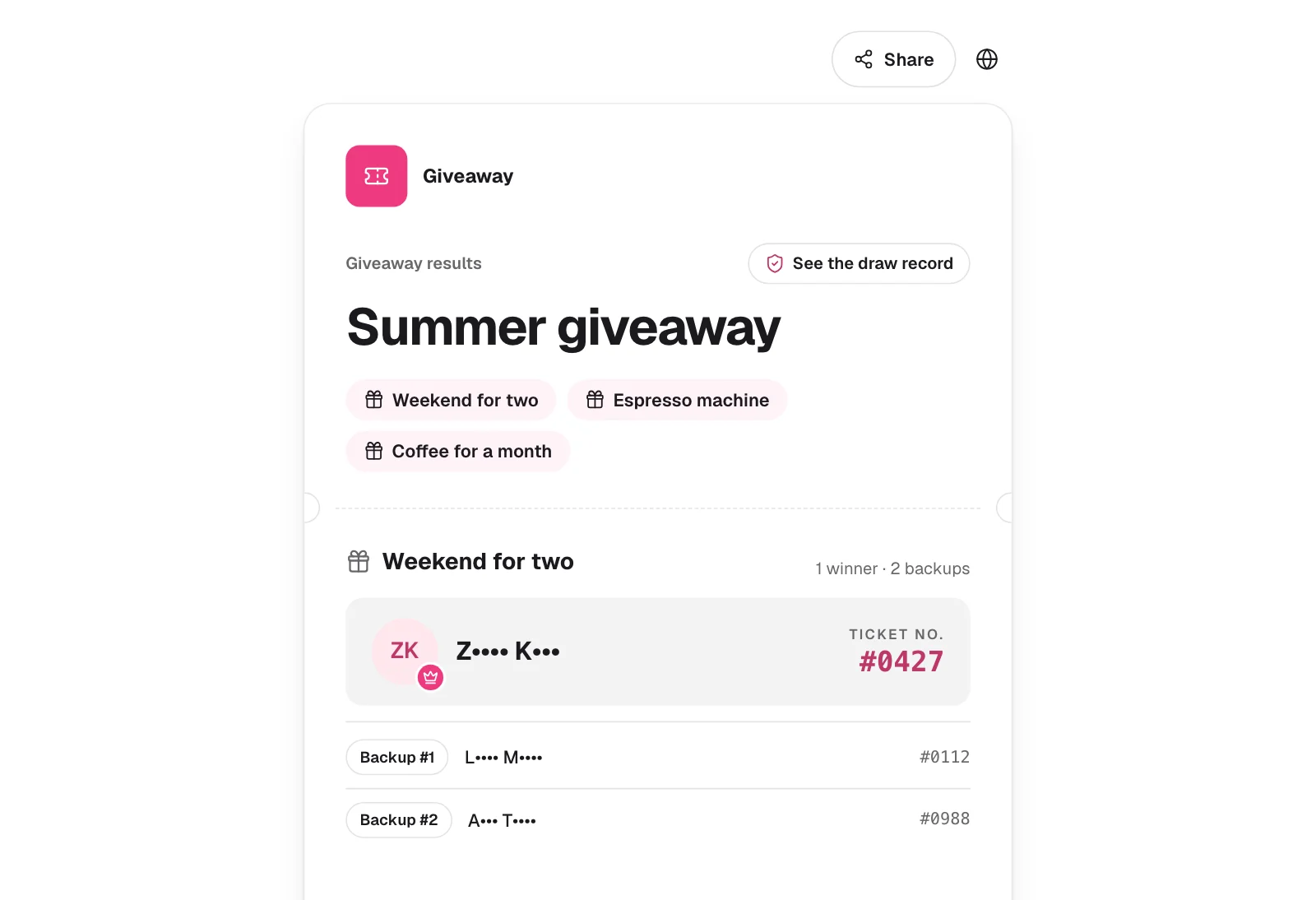
Publish the outcome where participants can find it: winners and backups with their ticket numbers, the date and time and the number of entries. You can mask part of each name for privacy, and you can describe the method in one sentence.
Behind the scenes, keep the saved entry list with its fingerprint, the draw's seed, a screen recording of the draw if it happened live and your rules. If anyone challenges the result, you can answer with documents instead of opinions.
Timing matters. Publish the result as soon as the draw finishes, before anyone has the chance to doubt it, and keep the records for as long as your rules or local regulations require.
What Winologic records for each draw
Winologic saves each draw with its random seed and a fingerprint of the entry list, both kept in your dashboard. The public results page shows the winners, their ticket numbers and when the draw ran, with names masked if you choose. You can also run the draw live on any of the seven draw screens so people watch it happen.
No tool can prove that entries were genuine or eligible. That part depends on your published rules and on checking entries before you freeze the list. Remove duplicates and obvious fake accounts first, according to criteria you published, so the list you fingerprint is the list you are willing to defend.
Frequently asked questions
What is a fingerprint or hash of an entry list?
+
It is a short code calculated from the whole list. If anything in the list changes, even a single character, the code changes completely, so a matching code shows the list is the same one used in the draw.
Can other people check a giveaway draw?
+
They can check what you publish: the rules, the winners with their ticket numbers, the date and the number of entries. Re-running the draw itself needs the saved seed, the exact entry list and the same method, so that record usually stays with the organiser, ready to show if someone formally challenges the result.
Do I need to record a video of the draw?
+
It is not required, but a live or recorded draw is the most persuasive proof for a public audience. Combine it with a saved entry list and a results page.
Should I publish the whole entry list?
+
Usually not, because it contains personal data. Publish the number of entries instead, and keep the full list and its fingerprint safely stored in case you need to show them to a regulator or auditor.
Related guides
All guidesA non-technical guide to random draws: what randomness means, what a seed is, why reproducible results matter and how fingerprints protect the entry list.
Announce giveaway winners in a way that builds trust: what to include, a public post and private message template, and how to share proof of the draw.
A plain-language checklist and general template for giveaway rules: eligibility, entry, dates, prizes, winner selection and privacy. Not legal advice.