How to Draw a Random Winner from a List of Names
Turn any list of names into a fair random draw: clean the list, remove duplicates, set winners and backups, and keep a record of the result.
By the Winologic team · Updated: · How we write our guides
To draw a random winner from a list of names, put every eligible name in one list, remove duplicates and anyone who breaks your rules, decide how many winners and backups you need, and let a random method choose instead of picking by hand. Save the final list and the result so you can show later what the draw was based on.
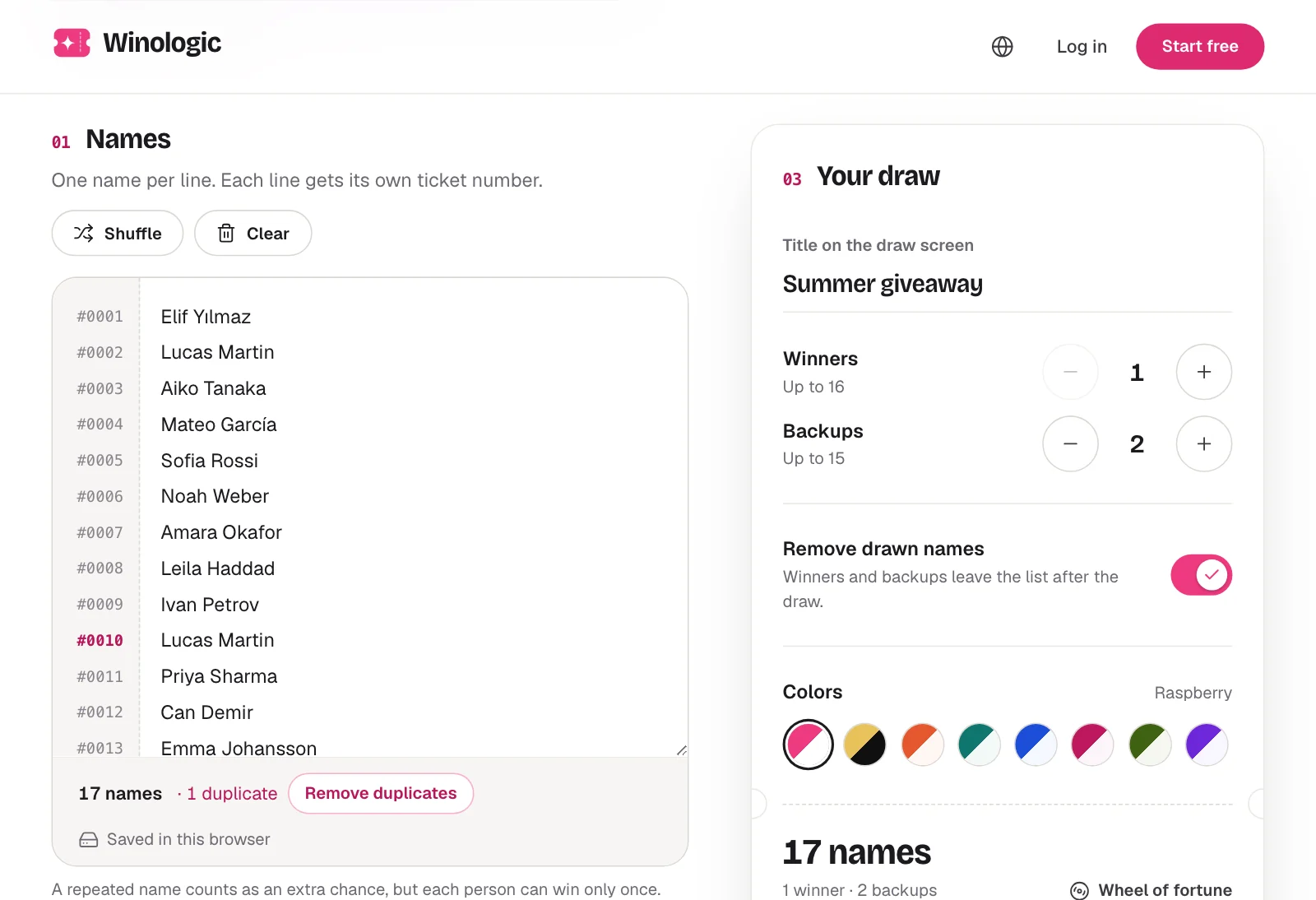
Freeze one final list before you draw
A fair draw starts with a list that nobody can change once the draw begins. Collect the names from your sign-up sheet, form, chat or spreadsheet, set a clear cut-off time and stop accepting additions at that moment. Names added by hand after the deadline are the most common reason a result gets challenged.
Then tidy the list: one person per line, the same spelling style throughout, no blank rows, and no organisers or family members if your rules exclude them. Save a dated copy of the final version so you can show exactly what the draw was based on.
- One name per line, no empty rows.
- Remove people who are not eligible under your rules.
- Remove duplicates so each person appears once.
- Save a dated copy of the frozen list.
Decide the draw settings first
Before anyone sees a result, decide how many winners you need, how many backups, and whether someone who has already won can win again. For example, one phone plus two backup winners, or five vouchers with three backups. Write these settings into your rules or announce them at the start of the draw.
Settle one more question in advance: does every person get exactly one chance, or can some earn extra tickets? Equal chances is the simplest option and the easiest to explain. If you do give extra tickets, publish how they are earned.
Why a random method beats choosing by hand
People are poor at being random. Even with the best intentions we drift towards names we recognise, names near the top of a list or ones that somehow feel due. A random draw gives every name on the list the same chance, so nobody has to defend a personal choice.
Pulling slips from a hat can also be fair, but it leaves no record. A digital draw can show the list it used and keep the result, which matters when someone asks six months later how the winner was chosen.
A random draw also protects you personally. If the winner is a friend of yours, or the person you secretly hoped for, nobody can accuse you of favouritism when the choice was made by chance from a list everyone can see.
Three ways to run the draw
Paper slips work for a small room: write each name on an identical slip, mix them well and let a guest pull them out. A spreadsheet works for a medium list: add a column of random numbers beside the names, sort by it and take the top rows. Both are fine for casual draws, though neither leaves strong evidence.
A dedicated draw tool is the best choice when you want a show or proof. In Winologic you can type names, bulk paste a list or import a CSV or Excel file, then reveal winners on a wheel of fortune, slot machine, card shuffle, name shuffle, elimination, countdown or scratch card screen. A quick draw even works without an account.
Record the result and announce it properly
Write down the date, the number of names, the settings and the winners as soon as the draw ends. Announce winners and backups together, in the order they were drawn, so everyone can see the backups were chosen at the same moment and not added later.
Winologic saves every draw with its random seed and a fingerprint of the entry list, both kept in your dashboard, and a public results page shows the winners, their ticket numbers and when the draw ran, with names masked if you prefer. That gives anyone who doubts the result something concrete to look at.
Step by step
- 01Collect the names
Gather names from every source into one list and set a clear cut-off time.
- 02Clean the list
Remove blanks, ineligible people and duplicates so each person appears exactly once.
- 03Freeze the list
Save a dated copy and stop accepting additions once the deadline passes.
- 04Set the draw
Choose the number of winners and backups before the draw begins.
- 05Draw at random
Use a random method, ideally live or recorded, instead of choosing by hand.
- 06Record and announce
Note the result, then announce winners and backups together.
Frequently asked questions
Is pulling names from a hat a fair way to pick a winner?
+
Yes, if the slips are identical, well mixed and every name appears once. The weakness is proof: nobody can check afterwards. For public giveaways a digital draw that records the list is easier to defend.
Should I draw backup winners?
+
Yes. Draw them in the same draw as the main winner, in order, so you can move to the next name if the winner does not reply or turns out to be ineligible. This avoids a second draw that people might question.
Can the same person win twice in one draw?
+
Only if you allow it. Most organisers remove a winner from the pool once they are drawn so one person cannot take several prizes. Winologic removes drawn people from the pool automatically.
How many names do I need for a draw?
+
There is no minimum for the draw itself, but with only a handful of names it is worth being honest about the odds. State in your rules what happens if too few people enter, for example extending the deadline.
Related guides
All guidesLearn what a random name picker really does, how computers generate chance and the checks that show whether a picker is fair enough for a giveaway.
Pick a fair random winner from a spreadsheet: prepare the columns, remove duplicates, draw with a formula or an import tool, and protect personal data.
Learn the four ingredients of a provable giveaway draw: published rules, a fixed entry list, a random method and a saved record of the result.